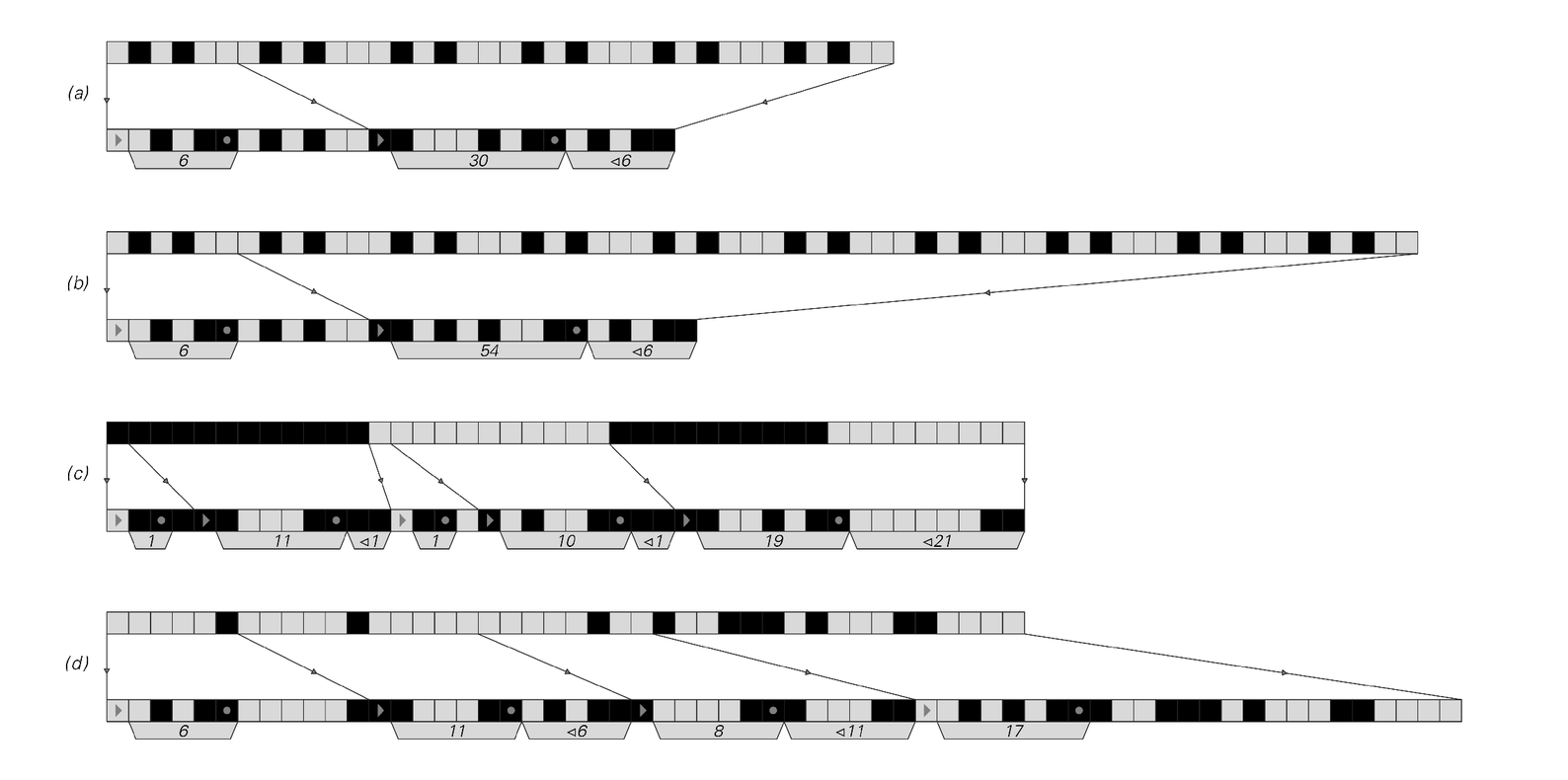
But ultimately there is a limit to the degree of compression that can be obtained with this method. For even in the very best case any block of cells in the input can never be compressed to less than one cell in the output.
So how can one achieve greater compression? One approach—which turns out to be similar to what is used in practice in most current high-performance general-purpose compression systems—is to set up an encoding in which any particular sequence of elements above some length is given explicitly only once, and all subsequent occurrences of the same sequence are specified by pointers back to the first one.
The pictures below show what happens when this approach is applied to a few short sequences. In each case, the output consists of two kinds of objects, one giving sequences that are occurring for the first time, and the other giving pointers to sequences that have occurred before. Both kinds of objects start with a single cell that specifies their type. This is