

Despite the fact that mobile automata update only one cell at a time, it is thus still possible for them to produce behavior of great complexity. But while we found that such behavior is quite common in cellular automata, what we have seen in this section indicates that it is rather rare in mobile automata.
One can get some insight into the origin of this difference by studying a class of generalized mobile automata, that in a sense interpolate between ordinary mobile automata and cellular automata.
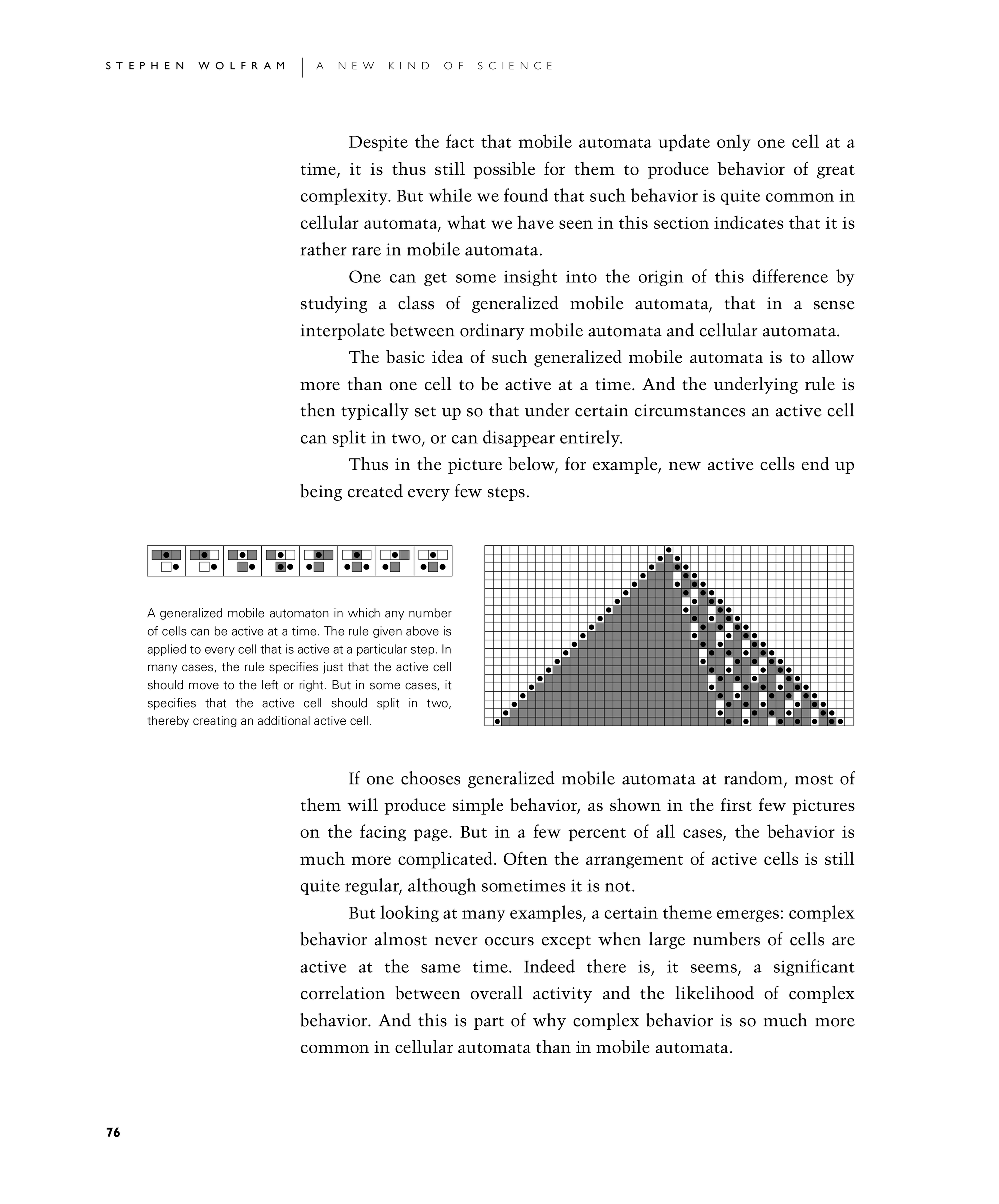
The basic idea of such generalized mobile automata is to allow more than one cell to be active at a time. And the underlying rule is then typically set up so that under certain circumstances an active cell can split in two, or can disappear entirely.
 | 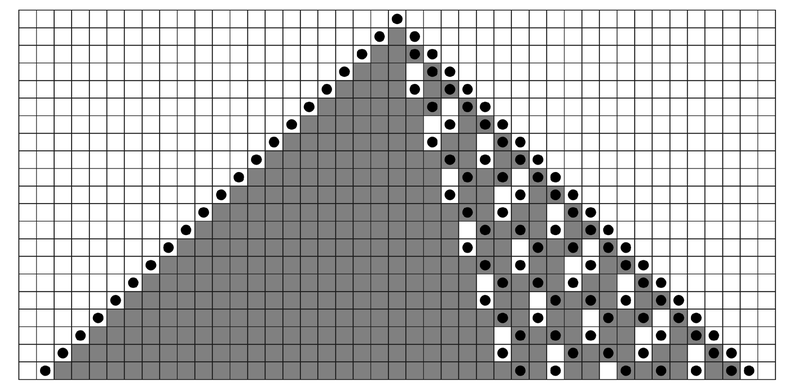 |
Thus in the picture below, for example, new active cells end up being created every few steps.
If one chooses generalized mobile automata at random, most of them will produce simple behavior, as shown in the first few pictures on the facing page. But in a few percent of all cases, the behavior is much more complicated. Often the arrangement of active cells is still quite regular, although sometimes it is not.
But looking at many examples, a certain theme emerges: complex behavior almost never occurs except when large numbers of cells are active at the same time. Indeed there is, it seems, a significant correlation between overall activity and the likelihood of complex behavior. And this is part of why complex behavior is so much more common in cellular automata than in mobile automata.