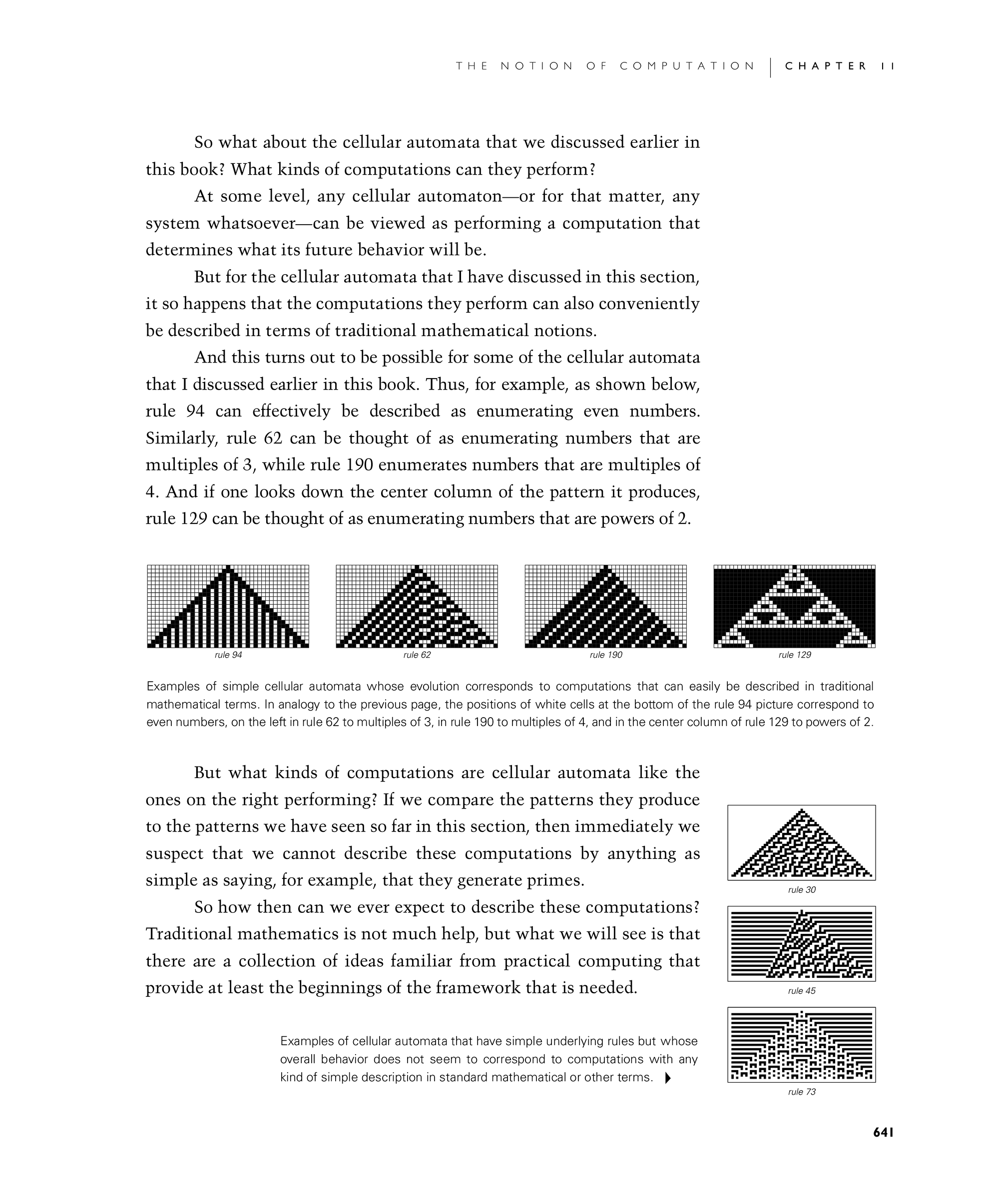
So what about the cellular automata that we discussed earlier in this book? What kinds of computations can they perform?
At some level, any cellular automaton—or for that matter, any system whatsoever—can be viewed as performing a computation that determines what its future behavior will be.
But for the cellular automata that I have discussed in this section, it so happens that the computations they perform can also conveniently be described in terms of traditional mathematical notions.
And this turns out to be possible for some of the cellular automata that I discussed earlier in this book. Thus, for example, as shown below, rule 94 can effectively be described as enumerating even numbers. Similarly, rule 62 can be thought of as enumerating numbers that are multiples of 3, while rule 190 enumerates numbers that are multiples of 4. And if one looks down the center column of the pattern it produces, rule 129 can be thought of as enumerating numbers that are powers of 2.

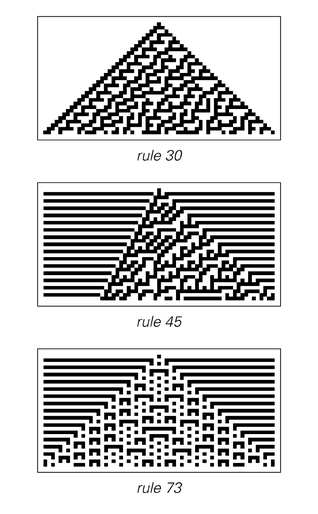
But what kinds of computations are cellular automata like the ones in the second set of pictures below performing? If we compare the patterns they produce to the patterns we have seen so far in this section, then immediately we suspect that we cannot describe these computations by anything as simple as saying, for example, that they generate primes.
So how then can we ever expect to describe these computations? Traditional mathematics is not much help, but what we will see is that there are a collection of ideas familiar from practical computing that provide at least the beginnings of the framework that is needed.