Notes

Chapter 8: Implications for Everyday Systems


Section 1: Issues of Modelling

Consequences of models Experiences of modelling Finding models [of systems] History of modelling Material for this chapter Models versus experiments Models versus reality Notes on this chapter Uncertainties of this chapter Universality in models

Section 2: The Growth of Crystals

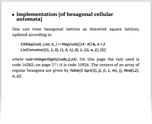
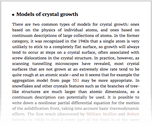
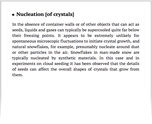
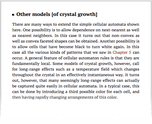
Amorphous materials Boiling Diffusion-limited aggregation (DLA) History of crystal growth History of snowflake studies Hopper crystals Identical snowflakes Implementation [of hexagonal cellular automata] Models of crystal growth Nucleation [of crystals] Other models [of crystal growth] Polycrystalline materials Quasicrystals
Section 3: The Breaking of Materials

Alternate models [of fracture] Crinkling Crushing [of solids] Effects of microscopic roughness Electric breakdown Experimental data [on fracture] History [of fracture] Large-scale fractures Models of microscopic fracture Phenomenology of microscopic fracture
Section 4: Fluid Flow

2D fluids Atmospheric turbulence Cellular automaton fluids Chaos theory and turbulence Computational fluid dynamics Convection Flows past objects Generalizations of fluid flow Geological structures Granular materials History of cellular automaton fluids Models of turbulence Navier–Stokes equations Ocean surfaces Reynolds numbers Sound waves and shocks Splashes Vorticity-based models

Section 5: Fundamental Issues in Biology

Adaptive value of complexity Analogies with thermodynamics Attitudes of biologists Belief in [biological] optimality [Biological] species Defining life Genetic algorithms Genetic programs [in biology] History [of biological complexity] Major new features [in biological evolution] Other models [of mutation] Proteins Smooth variables [in biology] Software [system] statistics Studying natural selection Tricks in [biological] evolution
Section 6: Growth of Plants and Animals

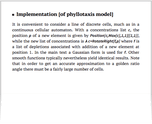
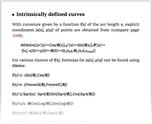
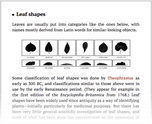
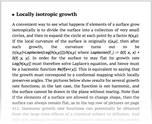
Animal behavior Antlers [Biological] self-assembly Bones Branching in animals Branching in plants Discrete folding [in biological growth] Embryo development General constraints on growth Growth in plants History of branching models History of embryology History of phyllotaxis History [of shell models] History [of theories of biological form] Implementation [of branching model] Implementation [of phyllotaxis model] Intrinsically defined curves Leaf shapes Locally isotropic growth Mathematical properties [of branching model] Mathematics of phyllotaxis [Mollusc] shell model [Mollusc] shells Multidimensional generalizations [of intrinsically defined curves] Observed phyllotaxis Parameter space sets Parametrizations of [biological] growth Pollen Projections of [phyllotaxis] patterns Radiolarians Schemes for [biological] growth Self-limiting growth Shapes of [biological] cells Simple geometries [in branching model] Symmetries [in biological systems] Tumors
Section 7: Biological Pigmentation Patterns

Animal coloration Animals [with patterning] shown Collecting shells Cowries Examples [of reaction-diffusion] in chemistry Excitable media Features of the [patterning] model History [of shell patterns] Implementation [of patterning model] Maze-like patterns Origins of randomness [in animal patterning] Reaction-diffusion processes Scales of patterns [on animals] Shell patterns
Section 8: Financial Systems

Details of trading Efficient markets Growth of cities Laws of human behavior Models of markets Motion of people and cars Properties of markets Randomness in markets Speculative markets Zipf's law

From Stephen Wolfram: A New Kind of Science [citation]